
AIRCRAFT INVESTIGATION >>>>>>> HOME PAGE
De Havilland Comet I accident report
Comet I at Entebbe airport 1952
On 21 January 1953 BOAC Comet 1 G-ALYY undershot the runway when landing at Entebbe, Uganda. One airport worker was killed. Aircraft damage to centre section flaps and port tyre holed

Location : +- 1500m 0°02’45”N 32°26’30”E

On 3 March 1953, a new Canadian Pacific Airlines Comet 1A, registered CF-CUN “ Empress of Hawaii”, failed to become airborne while attempting a night take-off from the 2500m long RW25 at Karachi, Mauripur RAF station , Pakistan, on a delivery flight to Australia. The aircraft, piloted by Captain Charles Pentland took off with a very high nose-up attitude. The wing stalled during the take-off run and as a consequence the aircraft could not gain speed due to the additional drag and could not get airborne. Pentland was an experienced pilot but had only 10 flying hours on the Comet. Take-off was at maximum weight at night with the horizon obscured by ground haze. The hot and thin air at Karachi more reduced take-off performance. Without no horizon and the powered controls giving no feedback the nose could be lifted easily more high than wanted. During take-off, while accelerating past a speed of 85 knots, the pilot raised the nose wheel. He should have levelled the plane until the nose wheel was just off the runway. Instead, he continued to roll nose-high. In this position wing drag increased, partially stalled, causing a slower than needed acceleration. Nearing the end of the runway, the pilot brought the nose down, but the remaining runway length was insufficient to reach rotation speed. The aircraft overshot the runway with a speed of 222 km/h and plunged into a dry drainage canal and collided with an embankment, and immediately, the fuel loaded plane burst into flames, killing all five crew and six passengers on board. The accident was the first fatal jetliner crash. In response, Canadian Pacific cancelled its remaining order for a second Comet 1A and never operated the type in commercial service. Pilot Pentland was initially blamed for the accident but cleared six years later. However De Havilland conducted take-off trials and this led to DH chief designer Ronald Bishop to redesign the leading edge with a slight droop. With this droop the wing did not stall anymore during take-off runs, even with the tail bumper scrapping the runway. and this problem was cured.

Location : +- 50m 24°53’55”N 66°55’01”E
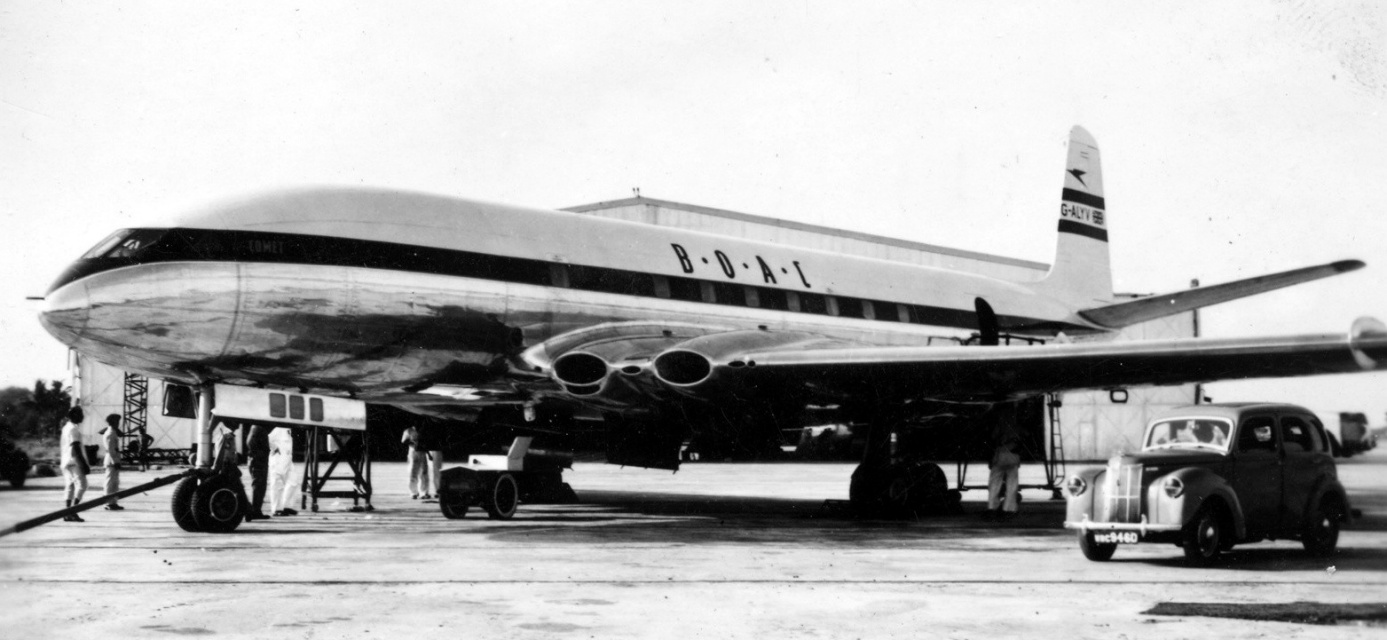
Saturday 02 May 1953 BOAC DH Comet I G-ALYV c/n 06008.
Flight BA783 from Calcutta- Dum Dum apt. (CCU), (now Netaji Subhash Chandra Bose International Airport ), India to Delhi with 6 crew and 37 passengers. Pilot in command was Maurice Haddon. Six minutes after take-off from RW 19l the aircraft got into a severe thunderstorm. The Comet broke up in flight at 2000m height. Witnesses observed the wingless Comet on fire plunging into the village of Jagalgori, 32km NW of Calcutta Dum Dum apt. leading investigators to suspect structural failure.
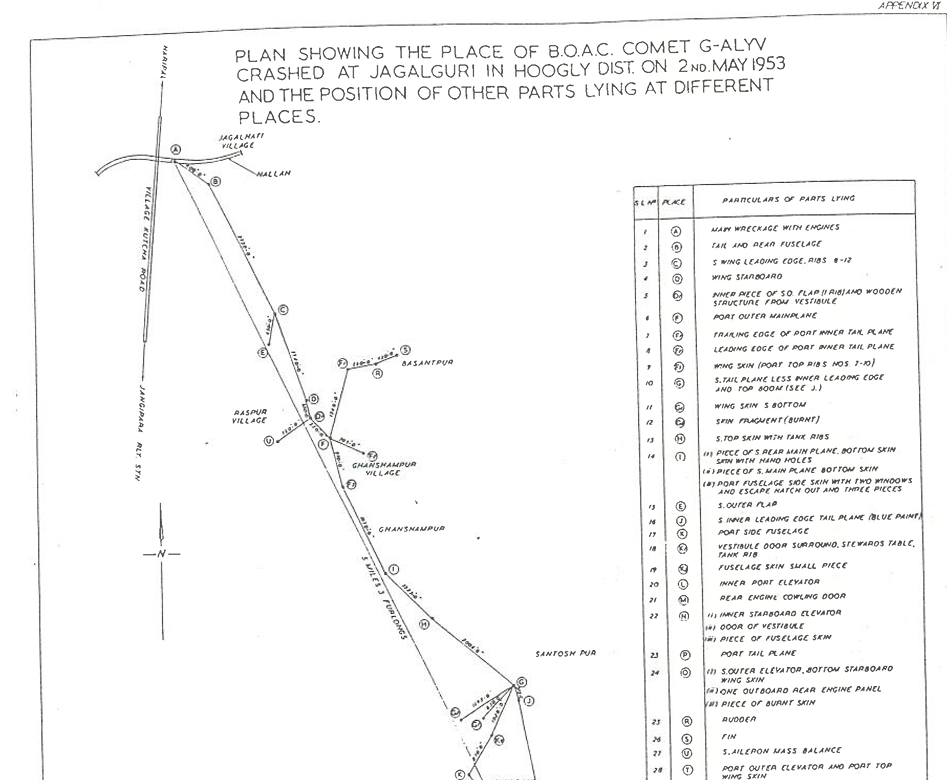
The wreckage was spread over 10km. First flight : 1952 Airframe hrs : 1649 engines : DH Ghost 50 mk.I. All 43 people on board died in the crash. Exact cause was never established. Possible cause over controlling. The powered controls gave no feedback of the actual forces on the rudders to the pilot, and this could lead to overstressing the aircraft. The aircraft broke up at a low height so decompression was not the prime suspect. After this incident later Comets got a weather radar installed. location : Jagalogori, 24 miles from Dum Dum apt. +- 1000m 22°46’07”N 88°04’34”E
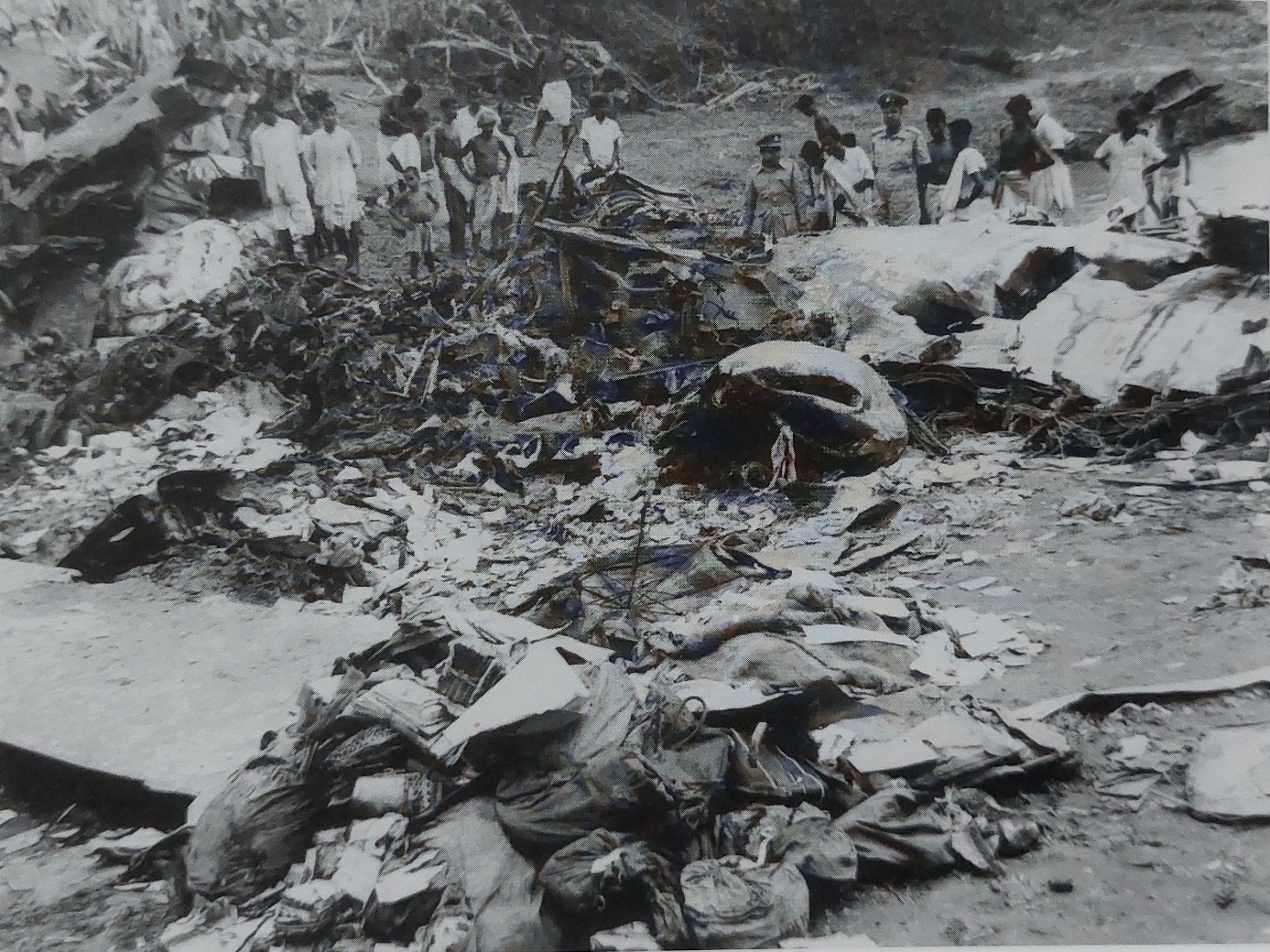
Remains of G-ALYV with engine parts, probably at location (A) on above map .
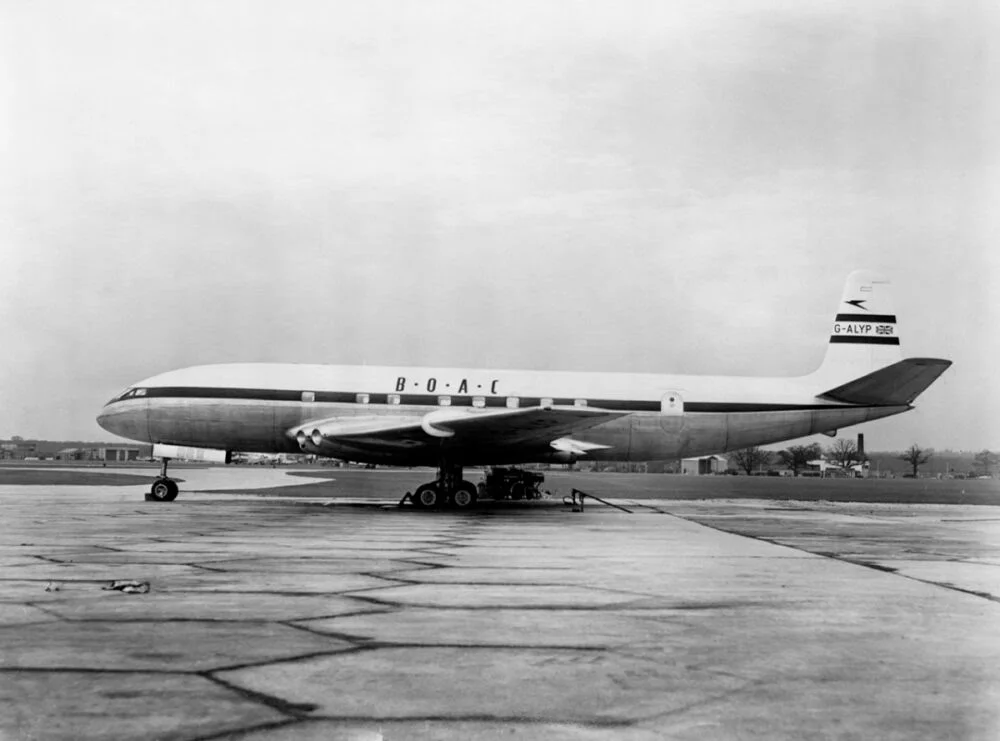
BOAC Comet I G-ALYP at Hatfield .
Sunday 10 January 1954 BOAC Comet I G-ALYP c/n 06003
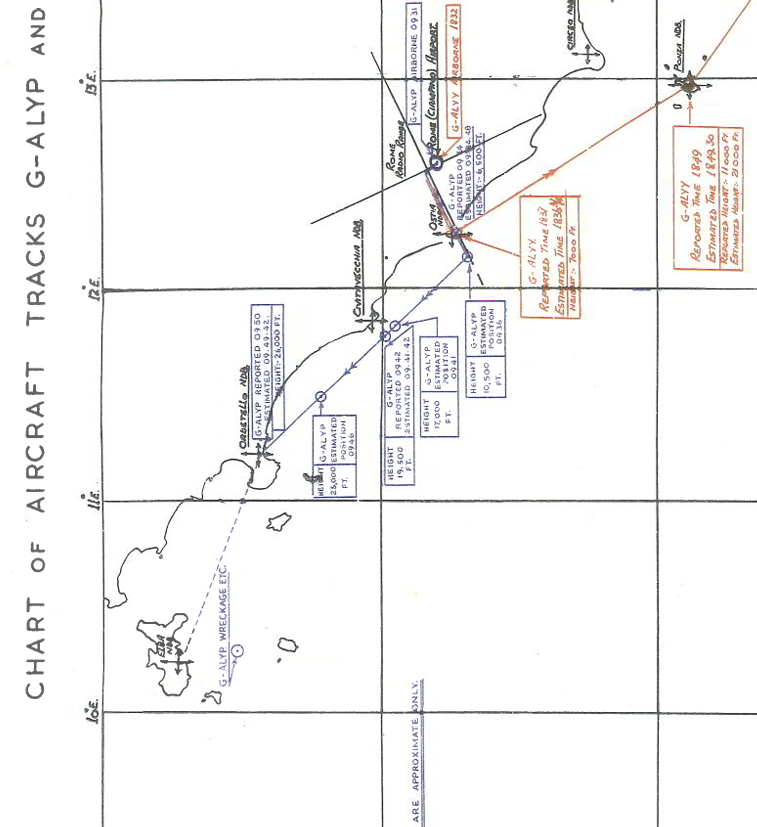
ISP Flight BA781 from Rome – Ciampino (CIA) to London (LHR) with 6 crew (pilot in command Alan Gibson) and 29 passengers. First service flight : May 1952 Twenty minutes after take-off at 27000 ft hight the aircraft broke up in flight and crashed into the Mediterranean 16 km south off the Italian island of Elba . Airframe hrs : 3681 engines : DH Ghost 50 All people died on board in the crash. G-ALYP was the first production Comet. With no witnesses to the disaster and only partial radio transmissions as incomplete evidence (some floating debris and 15 bodies, first pieces of wreckage found on the seabed on 12 February 1954), no obvious reason for the crash could be deduced. The serious injuries found on the bodies gave strong evidence of explosive decompression. It had to be found out what caused the decompression.
Engineers at de Havilland immediately recommended 60 modifications aimed at any possible design flaw, while the Abell Committee met to determine potential causes of the crash. As there were suspicions of technical issues, BOAC, Air France and SAA decided to suspend all Comet flights. After fifty modifications and improvements, the Comet started operations again two months later, on 23 March 1954. But two weeks later on 8 April 1954 G-ALYY broke up in flight. Now the Comet's Certificate of Airworthiness was revoked, and the fleet was grounded once more.
The wreckage of G-ALYP had sunk to a depth of 125 - 180m, and while G-ALYY wreckage lay to deep (1000m) for salvage all effort was placed on retrieving as much as possible of G-ALYP from the seabed.
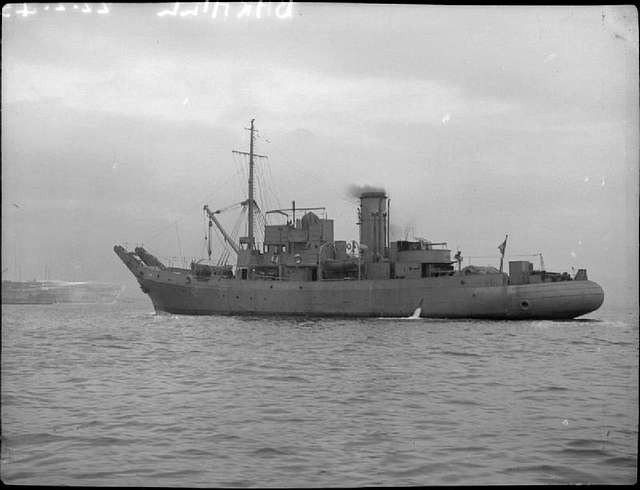
Boom defence vessel HMS Barhill, with its nets, it could lift remains of G-ALYP from the seabed
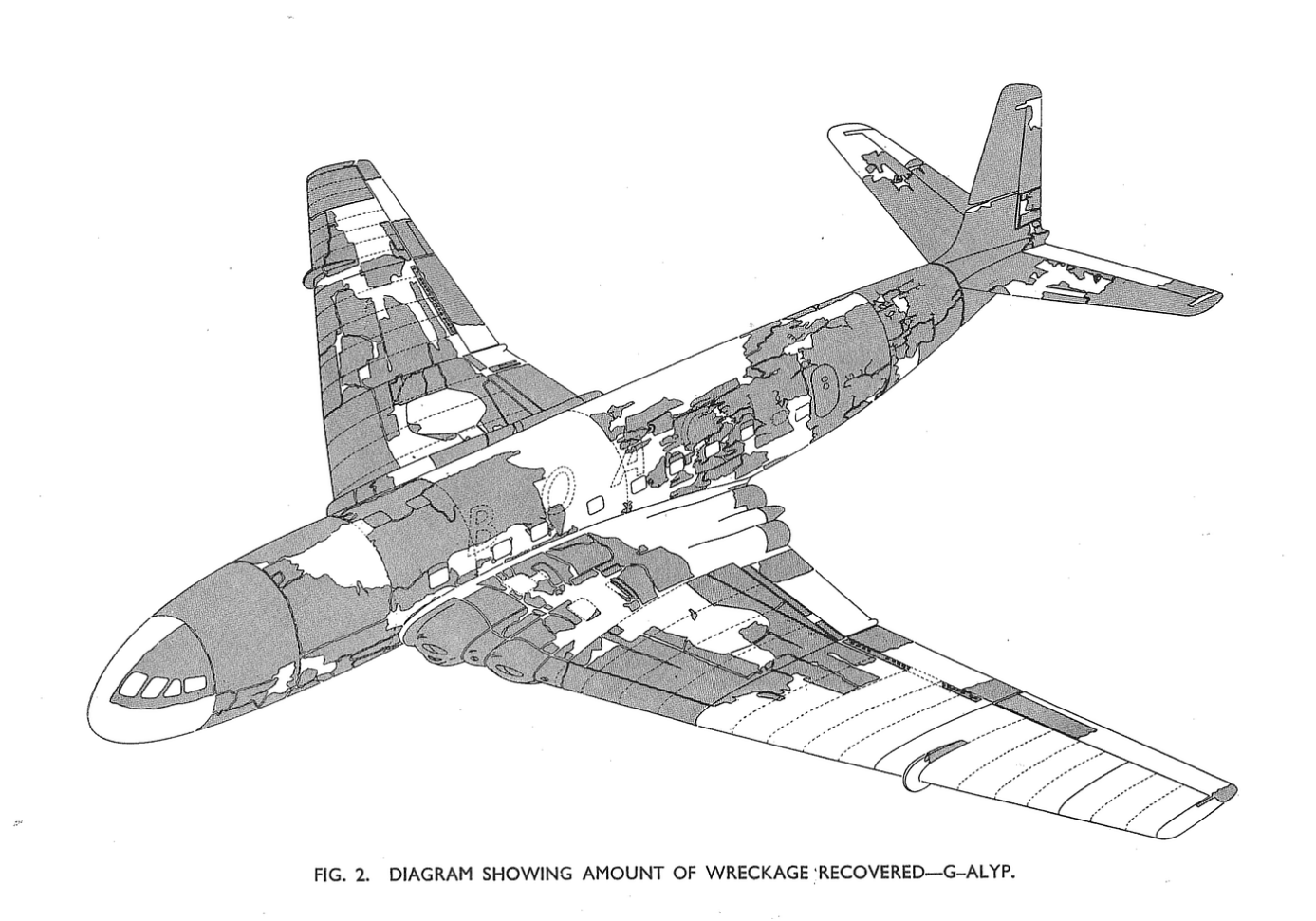
The search for the wreckage included the Royal Navy ships Bar-class boom defence vessel HMS Barhill and light cruiser HMS Gambia as well as the Maltese civilian salvage vessel Sea Salvor . About 70% of the debris was recovered with the help of underwater cameras, and the airplane was rebuilt in the UK for investigations. It was eventually discovered that the airplane suffered a structural failure and exploded in flight. location : between Cape Calamita at Elba and Monte Cristo +-3km 42°31’55”N 10°15’0”E
 .
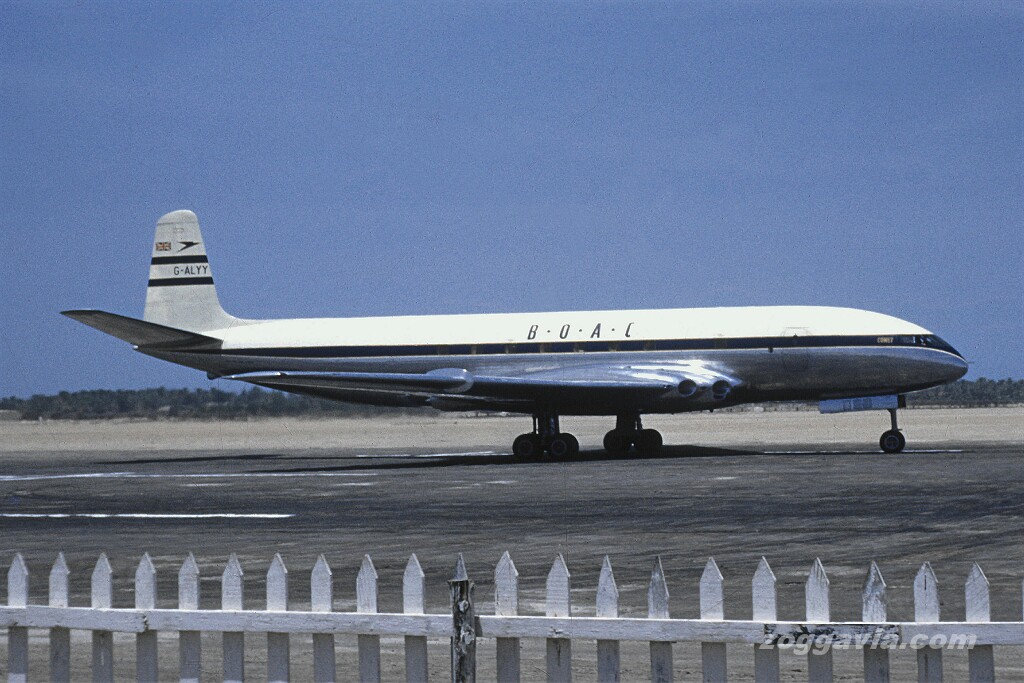
On Thursday 8 April 1954, Comet G-ALYY ("Yoke Yoke"), c/n 06011 on charter with South African Airways , was on a leg from Rome-Ciampino apt. (CIA) to Cairo (CAI) (of a longer route, SA Flight 201 from London to Johannesburg), when broke up in flight while climbing to 35.000ft and crashed in the Mediterranean sea near Naples with the loss of all 14 passengers and 7 crew on board. The Comet fleet was immediately grounded once again and a large investigation board was formed under the direction of the Royal Aircraft Establishment (RAE). Prime Minister Winston Churchill tasked the Royal Navy with helping to locate and retrieve the wreckage so that the cause of the accident could be determined. The Comet's Certificate of Airworthiness was revoked, and Comet 1 line production was suspended at the Hatfield factory while the BOAC fleet was permanently grounded, cocooned and stored. The main wreckage sank to a depth of 3500ft (1067m) and could not be salvaged, all that was recovered was floating debris and 6 corpses . Based on the findings of the accident to G-ALYP, it was concluded that G-ALYY must also have suffered structural failure of the pressure cabin, due to fatigue. First flight : 1952 Airframe hrs : 2704 engines : DH Ghost 50 location : ca. 17km W. of San Lucido, Italy +-5km 39°09’03”N 15°32’58”E .

At first metal fatigue research focussed on the wings, which were expected to fail first from metal fatigue for their constant bending, and in fact this happened to some propellor airliners. Metal fatigue was not something new, it was already described in 1850. Metal/aluminium airliners came only on a larger scale in service after WWII and more in flight braking up occurring at the start of the 50’s can have happened as the aircraft in service build up more flying hours, and at this moment, metal fatigue being a more or less new phenomenon for the aviation industry. With the Comet disasters it became clear that also the pressurized fuselage was under metal fatigue strain.
But before the 1954 Comet disasters, in 1953 De Havilland was already testing pressure cycles, exceeding the new regulations, and carried out 18000 pressurization cycles on full-scale test sections of the Comet I fuselage before there was a failure. At that moment Comet’s in service had only around 2500 flying hours, ca. 800 cycles, so it seemed the fuselage was built save for many years of service.
However, the wing of G-ALVG was also under stress tests and in December 1953 cracks were found after only 6000 years, meaning that the aircraft in service were safe to operate but needed more inspection sooner than expected. But this problem was overshadowed by the crash of G-ALYP in January 1954.
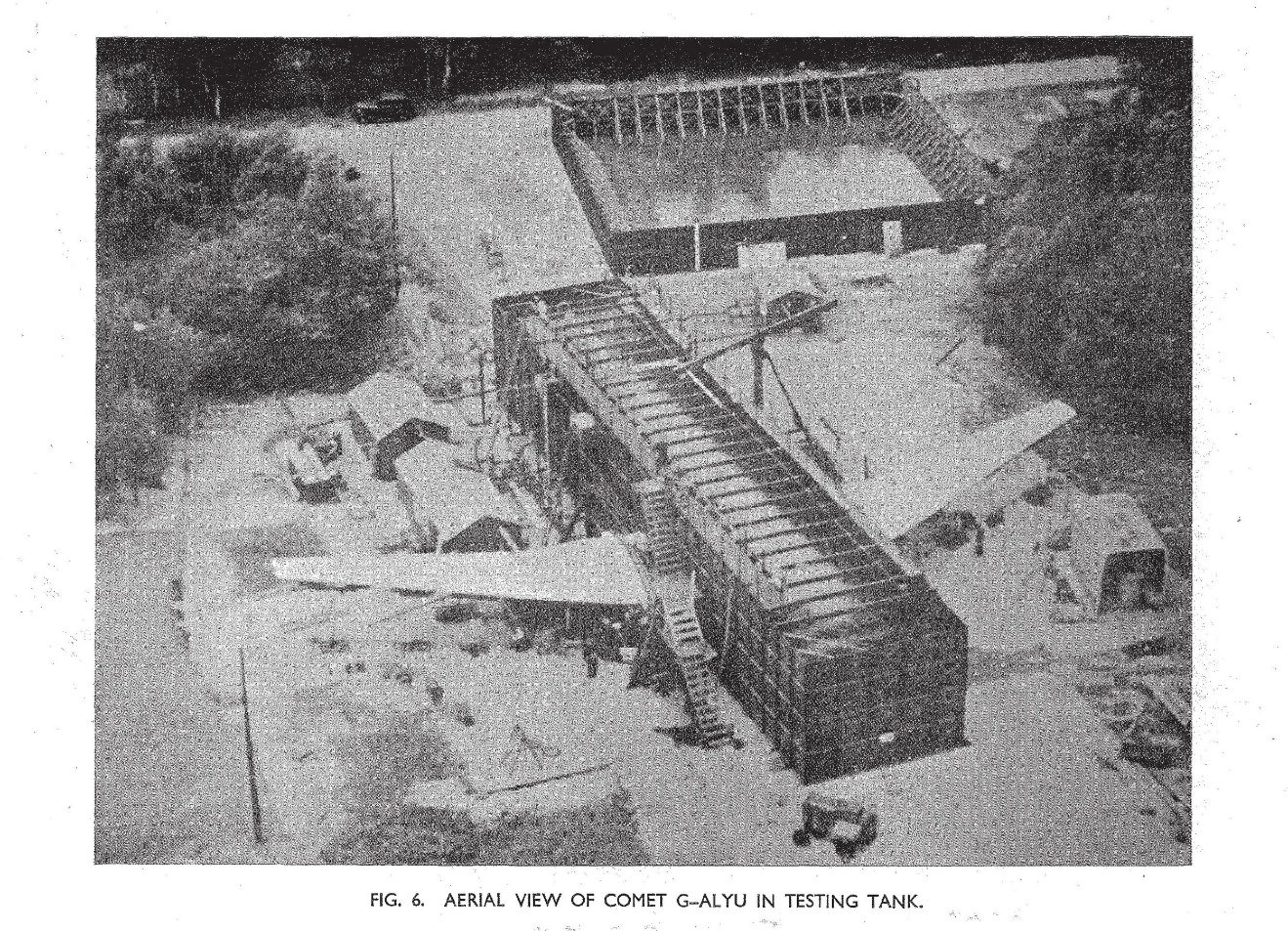
A large investigation, led by RAE (Royal Aircraft Establishment) director sir Arnold Hall , was undertaken to determine the cause of the accidents.
G-ALYU was taken apart at London airport and moved by Pickford trucks to Farnborough. There it was submerged in a special built water tank to conduct stress test under water pressure. On 24 June 1954 after 3057 flight cycles G-ALYU burst open. The square windows and escape hedges gave more stress in the skin than expected. On 12 August 1954 finally a part of the fuselage of G-ALYP arrived at Farnborough that clearly showed metal fatigue failure, confirming the findings in the water tank. Differences between the earlier De Havilland test (failure after 18000 cycles) and G-ALYU in the water tank and G-ALYP in flight came from the fact that De Havilland did not use a complete fuselage, only sections with not all windows in place. And the windows in the DH test were Reduxed , what was foreseen also for production, however in production this gave problems to realise, and they were punch riveted only, giving more concentrated stress points. The shape of the Comet passenger windows was not the main culprit, they had rounded corners, but more that during construction the windows were push riveted and not glued ( Redux ).
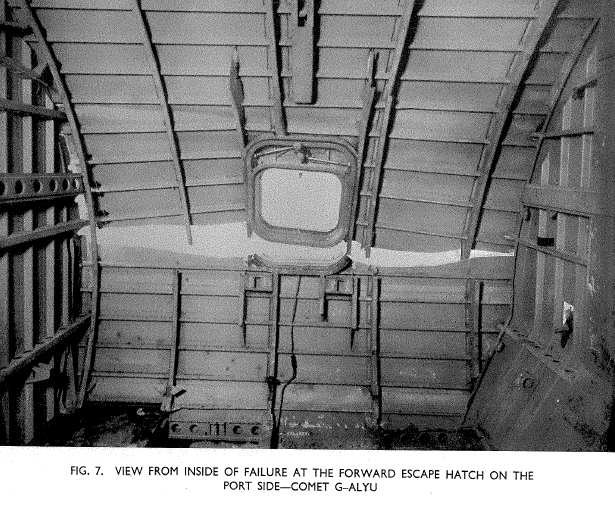
In the water tank G-ALYU failed at the forward escape hatch window, 24 June 1954.

The fatigue crack failure for G-ALYP started at the aircraft ADF antennae “windows” in the roof of the fuselage. They were punch-riveted only, not glued (Redux). These parts were recovered from the seabed and arrived at Farnborough 12 august 1954.
Unlike drill riveting, the imperfect nature of the hole created by punch-riveting could cause fatigue cracks to start developing around the rivet.

Remains of G-ALYP were recovered from the seabed and put on a frame at Farnborough for reconstruction. This process was led by Eric Ripley, principal scientific officer of the RAE.
In the autumn of 1954, the result of the inquiry was published. No one was blamed; the Comet was designed, built and tested conform the standards and knowledge available at that time. But it was recommended to modify the flying control system to give the pilots more feeling of the loads applied on the rudders. All results of the inquiry were made available for the aviation industry. New variants of the Comet, but also other jetliners would get rounded or strengthened windows in future. Now metal fatigue was better understood, and aircraft fuselages could be made stronger with the new insights.

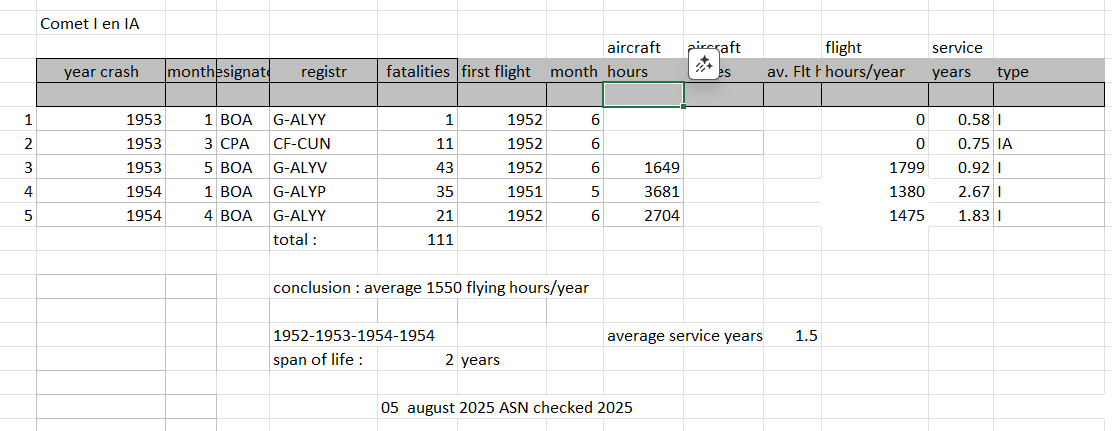
Literature :
De Havilland Comet – Haynes pages 102 – 121
de Havilland Comet - Wikipedia
air-britain.com/pdfs/archive/Archive_1998.pdf .
.
.
..